Security and identity
Every agent gets its own registered, short-lived identity with minimal access, and a rules engine the agent cannot bypass approves or blocks each consequential action.
Target state
In short: Each agent gets its own short-lived, minimal-access account, and a rules engine it cannot bypass approves every action that matters.
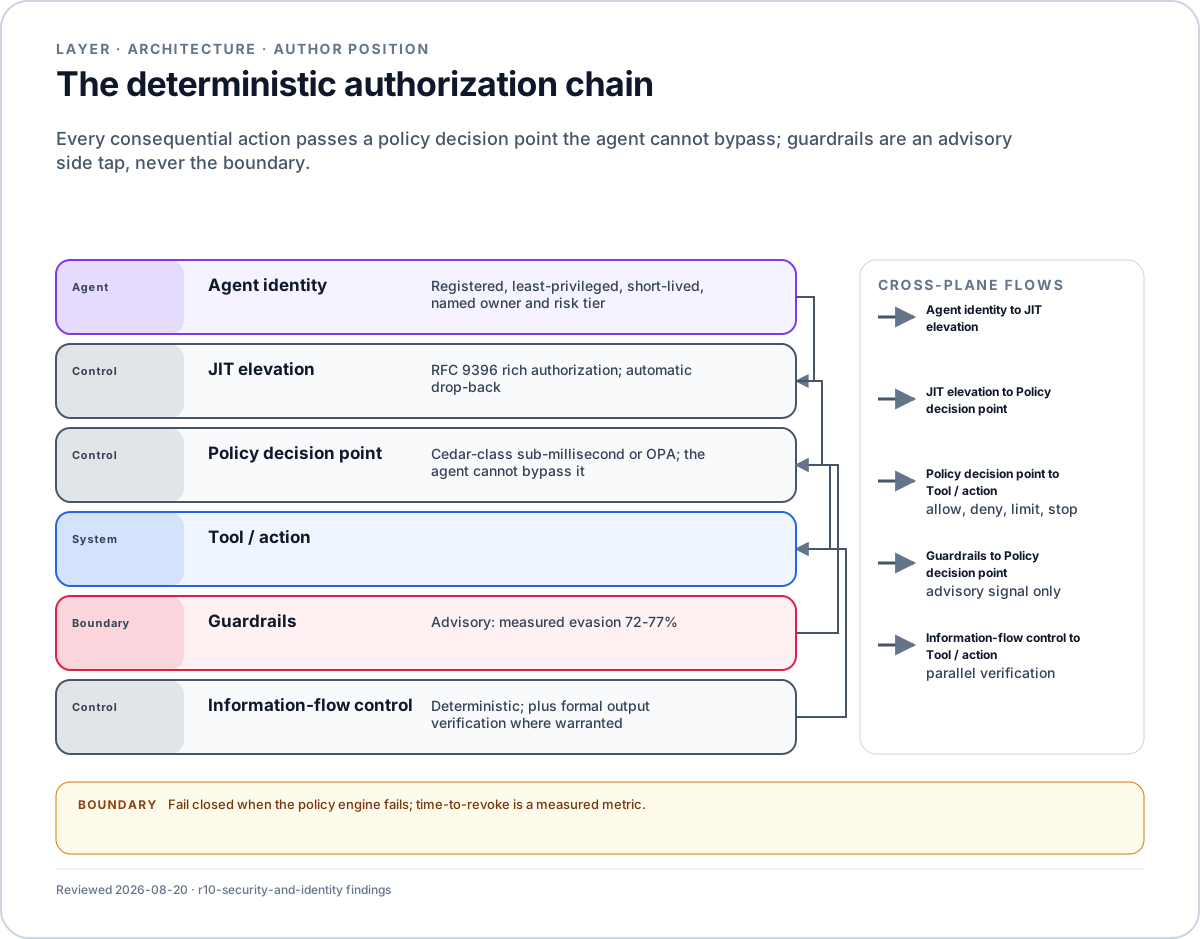
Identity is the perimeter. Every control in this layer depends on the agent having a first-class identity of its own. Each agent holds a registered identity with a named owner and a risk tier. The identity is short-lived and follows least privilege: it carries only the access the current task needs. Shared human credentials do not exist. A small set of durable teammate agents may hold presence-grade capability: a mailbox, a meeting seat, or visibility in the directory. That is granted per capability surface, the list of what the agent can actually do. It is granted only where the business sponsor accepts that the agent becomes discoverable and can be phished. All consequential actions pass a deterministic policy decision point (PDP): the component that says yes or no to each action by fixed rules. It sits in the path of every tool call, the moment an agent reaches into a real system, and the agent cannot bypass it. Probabilistic detection, meaning signals that are best guesses rather than fixed rules, feeds the security operations centre (SOC) through the security information and event management (SIEM) system. Agent-specific runbooks and new types of evidence come with it. Guardrails, the AI-based content filters, run as an advisory layer and never as the boundary. In the four zones (access control, money movement, safety actuation, regulatory records) the decision itself stays deterministic: models may inform, never decide. This layer decides; the R03 gateway enforces what its identities and policies decide.
layer · architecture
The deterministic authorization chain
Every consequential action passes a policy decision point the agent cannot bypass; guardrails are an advisory side tap, never the boundary.
- 01Agent
Agent
Agent identity
Registered, least-privileged, short-lived, named owner and risk tier
- 02Control
Control
JIT elevation
RFC 9396 rich authorization; automatic drop-back
- 03Control
Control
Policy decision point
Cedar-class sub-millisecond or OPA; the agent cannot bypass it
- 04System
System
Tool / action
- 05Boundary
Boundary
Guardrails
Advisory: measured evasion 72-77%
- 06Control
Control
Information-flow control
Deterministic; plus formal output verification where warranted
Fail closed when the policy engine fails; time-to-revoke is a measured metric.
Diagram description: Authorization chain from registered agent identity through just-in-time elevation and the gateway to a policy decision point and the tool, with guardrails as an advisory side channel and verification stages in parallel. The map contains Agent identity: Registered, least-privileged, short-lived, named owner and risk tier; JIT elevation: RFC 9396 rich authorization; automatic drop-back; Policy decision point: Cedar-class sub-millisecond or OPA; the agent cannot bypass it; Tool / action; Guardrails: Advisory: measured evasion 72-77%; Information-flow control: Deterministic; plus formal output verification where warranted. Its connections are identity to jit; jit to pdp; pdp to tool for allow, deny, limit, stop; guardrail to pdp for advisory signal only; ifc to tool for parallel verification. Important boundary: Fail closed when the policy engine fails; time-to-revoke is a measured metric.
- Component
- Agent identity plane
- Responsibility
- Register every agent; issue short-lived credentials
- Control it hosts
- Owner and risk tier per agent; just-in-time (JIT) elevation with automatic drop-back; kill switch; time-to-revoke
- Where it runs
- Your existing identity provider (IdP) estate; all four major identity vendors made agent identity generally available (GA) within twelve months
- Component
- Policy decision point
- Responsibility
- Allow or deny every consequential tool call
- Control it hosts
- Policy-as-code (Cedar or Open Policy Agent (OPA) class); fail closed when the engine is down
- Where it runs
- In the tool-call path, behind the R03 gateway
- Component
- Flow and output verification
- Responsibility
- Deterministic checks beyond allow or deny
- Control it hosts
- Information-flow control (FIDES class); formal-logic output verification
- Where it runs
- Agent framework and model platform runtime
- Component
- Guardrail layer
- Responsibility
- Advisory content screening
- Control it hosts
- Content policy, personal data (PII) detection, telemetry enrichment; never authorisation
- Where it runs
- Platform-native or standalone, off the boundary
- Component
- SOC pipeline
- Responsibility
- Detect and respond to agent incidents
- Control it hosts
- Detections mapped to MITRE ATLAS and OWASP; agent runbooks; reasoning traces and mandate logs as evidence
- Where it runs
- Existing SIEM and SOC estate
- Component
- Payment mandate infrastructure
- Responsibility
- Bound agent purchasing authority
- Control it hosts
- Scoped delegation tokens and signed verifiable credential (VC) mandates; real-time revocation
- Where it runs
- Issuer and network side (Visa Trusted Agent Protocol, Mastercard Agent Pay, Google Agent Payments Protocol), consumed by your agents
Mechanisms
The threat canon
In short: Four public documents now define how agents get attacked, and the weakest spots are what agents remember and how much people trust them.
Four documents define the mid-2026 threat model. The first is the Top 10 for Agentic Applications from the Open Worldwide Application Security Project (OWASP), released 9 December 2025. It runs from ASI01 (goal hijack) to ASI10 (rogue agents). Two of its entries reshape enterprise controls. ASI06 memory poisoning turns agent memory into a way for an attacker to persist. ASI09 human-trust exploitation makes agent-to-human communication an attack surface. The second is MITRE ATLAS (Adversarial Threat Landscape for Artificial-Intelligence Systems). It added fourteen agent-focused techniques in October 2025 and now stands at 16 tactics, 84 techniques, and 42 case studies. The third is Microsoft's failure-mode taxonomy v2.0 (June 2026). It counts 99 CVEs in 2025 alone that relate to the Model Context Protocol (MCP), the open standard that plugs agents into tools. A CVE is a publicly catalogued vulnerability (Common Vulnerabilities and Exposures). The fourth is joint adoption guidance from six national cyber agencies (April to May 2026). It names five risk categories and gives two rules: start low-risk, and grant no broad access. The canon lands on an identity baseline. Non-human identities outnumber humans by roughly 100 to 1, and 97 percent of them hold more access than they need [vendor]. Only 23 percent of organisations have a formal agent identity strategy (Cloud Security Alliance and Oasis survey, January 2026 [sponsored]). In the same survey, 92 percent doubt that legacy identity and access management (IAM) can manage the risk.
Identity mechanics: JIT, RAR, revocation
In short: Each agent gets a named account, extra access only while a task needs it, and a tested way to revoke it.
Register every agent with a named owner and a risk tier, and remove shared credentials first. Least privilege for agents means just-in-time (JIT) elevation over a minimal baseline, with automatic drop-back. Standing permissions stay minimal. Extra access is granted per task, and it expires on its own. This was published as the least-privilege pattern for agents in July 2026 [vendor]. Authorising a single action uses OAuth Rich Authorization Requests (RAR, the internet standard RFC 9396). RAR puts the specific action's parameters inside the access token instead of granting a broad scope. Credentials are short-lived and cryptographically anchored, the term used by the US Cybersecurity and Infrastructure Security Agency (CISA) in its guidance. The US National Institute of Standards and Technology's National Cybersecurity Center of Excellence (NIST NCCoE) has a demonstration project dated February 2026. It composes OAuth, SPIFFE, and MCP into exactly this chain. SPIFFE (Secure Production Identity Framework for Everyone) is the standard that gives running software its own proof of identity. The kill switch is an identity-platform feature, not an afterthought. Okta shipped one at general availability in April 2026 [vendor]. Time-to-revoke an agent credential is the metric that proves the switch works; drill it. The estate is ready: all four identity majors made agent identity generally available within twelve months [all vendor]. The dates are CyberArk November 2025, Okta April 2026, SailPoint May 2026, and Entra's agent registry converging into Agent 365 in April 2026.
The policy decision point
In short: A rules engine the agent cannot skip approves or blocks each consequential action; if the engine is down, actions stop.
The authorisation boundary is policy-as-code in the tool-call path: rules written as versioned code, evaluated by a PDP the agent cannot bypass. It is enforced at the R03 gateway, the single door every agent request passes through. Engine choice is a trade between properties. Cedar evaluates in under a millisecond and is formally verified, but it is stateless. Open Policy Agent (OPA) with its Rego language handles richer joins against external data. OpenFGA and SpiceDB cover relationship-based authorisation. Two deterministic complements shipped in 2025 and 2026. Microsoft's FIDES information-flow control, in Agent Framework v1.3, held the AgentDojo test to zero policy-violating prompt injections, against 20 to 152 without it [vendor]. A prompt injection is an instruction hidden in content the agent reads. Bedrock Automated Reasoning checks (GA 6 August 2025) verify outputs against formal logic [vendor]. The PDP fails closed: when the engine is down, consequential actions stop.
Guardrails are advisory
In short: AI-based filters miss most real attacks in published tests, so they may warn but never decide whether an action goes ahead.
Published measurement settles this. In one study (the LLMSEC 2025 workshop of the Association for Computational Linguistics, ACL), roughly 72 percent of attacks got past Azure Prompt Shield. Protect AI v1 let 77 percent through, and NeMo jailbreak detection let 72.5 percent through. In some configurations the figure rose to 100 percent. The one configuration measured at zero percent bypass paid for it with 16.22 percent false positives (legitimate requests wrongly blocked) and roughly 1.5 seconds of added latency (arXiv 2605.06669). Latency alone separates the layers. A policy engine evaluates in under a millisecond to a few milliseconds. One large language model (LLM) guardrail call takes roughly 1.5 seconds. That is three orders of magnitude, roughly a thousand times slower. Guardrails are also themselves a target: an attacker can trip the guardrail on purpose to cause a denial of service (arXiv 2410.02916). The position this evidence forces: guardrails keep their value for content policy, detection of personal data (PII, personally identifiable information), and telemetry, where a miss is tolerable. They never authorise an action.
The mandate-bound payment stack
In short: The card networks now issue signed spending permissions that cap what an agent can buy, and the agent itself cannot alter them.
The card networks built the deterministic-boundary architecture independently. That is the strongest convergence evidence in this layer. Visa Trusted Agent Protocol (October 2025) uses issuer-anchored delegation tokens scoped by amount, merchant, and category. Mastercard Agent Pay (April 2025) uses agentic tokens bound to agent, merchant, and consent, revocable in real time. Google Agent Payments Protocol (AP2, September 2025, more than 60 partners) uses cryptographically signed mandates carrying hard constraints, in the World Wide Web Consortium (W3C) Verifiable Credential format. A mandate is a signed, scoped permission to spend: how much, with whom, for what, until when. All three are deterministic authorisation consuming probabilistic signals. The caveat this guide states plainly: the mandate does not protect intent formation. AP2 was red-teamed in January 2026 with prompt injection that operated inside the mandate's bounds. The gate bounds the blast radius. Defending against injection upstream, and having a human confirm intent, remain necessary.
The four zones, zone by zone
In short: For access, money, safety and official records, a model may advise but a fixed rule makes the final call.
Decisions in the four zones are made by deterministic rules over verifiable credentials and policies. Model outputs are advisory inputs (see deterministic zones). Three zones already run machine learning (ML) signals inside them, and that is the design, not a violation. Entra ID Protection feeds ML risk scores into deterministic Conditional Access. Mastercard Decision Intelligence scores every network transaction while authorisation stays rule-bound. Filings are drafted with AI and then attested under fixed rules: a person confirms the record, the model only drafts. Safety actuation is the one zone where standards exclude ML from the function itself. IEC 61511 is the International Electrotechnical Commission (IEC) standard for safety instrumented systems, the certified equipment that shuts a process down safely. It requires that the safety instrumented system not use AI. ISO/IEC TR 5469:2024, the technical report on AI and functional safety, frames AI outside the deterministic safety function. Records regimes mandate accountability and immutable records, not deterministic generation. The US Financial Industry Regulatory Authority (FINRA) confirmed in notice 24-09 (June 2024) that technology-neutral obligations continue to apply. FINRA 25-07 (April 2025) asks for comment rather than settling a new interpretation. The European Securities and Markets Authority (ESMA) said the equivalent in May 2024. Deloitte Australia's partial contract refund (roughly A$440,000, October 2025) is the cautionary case.
The structural finding
In short: A model cannot reliably tell instructions from data, so the protection has to sit outside the model.
Why the boundary must be architectural: a transformer treats every token (the small unit of text a model reads) the same way. It therefore cannot separate commands from data by training alone (Bhattarai and Vu, February 2026). Without mediation built into the architecture, authorisation holds only until someone discovers the next exploit. EchoLeak (CVE-2025-32711, severity 9.3 out of 10 on the Common Vulnerability Scoring System, CVSS) is the incident that shows it. It was zero-click exfiltration through a Copilot-attached mailbox, and the injected instructions were indistinguishable from content at the token level. Unit 42 has since documented indirect prompt injection in the wild. The design consequence runs through every mechanism above. Assume injection sometimes succeeds. Identity scoping, the PDP, and mandates exist to bound what a compromised agent can do.
Design decisions
- SIEM extension vs dedicated AI-security platforms (CD-13), a challenged default about where agent security monitoring should live. The market is resolving toward platform absorption. There were six AI-security acquisitions in roughly fourteen months: Cisco/Robust Intelligence 2024; Palo Alto/Protect AI July 2025; SentinelOne/Prompt Security about $250 million; F5/CalypsoAI $180 million; CrowdStrike/Pangea about $260 million; and Check Point/Lakera about $300 million. Two non-human identity (NHI) deals came on top: Cisco/Astrix about $400 million and Cyera/Oasis about $1 billion. Buy accordingly, but absorption is not parity. Behavioural baselining of agents remains unsolved in mainstream SIEMs, and guardian agents persist as a distinct runtime category (Gartner: 10 to 15 percent of the agentic market by 2030). Independents differentiate on agent-graph posture and research depth.
- Standalone guardrail engines vs platform-native plus deterministic gates (CD-16), a challenged default about where content filters should run. Deterministic gates own the authorisation boundary. Guardrails are advisory wherever they run. Choose standalone guardrails for content policy and PII coverage across models, and platform-native where the platform already hosts the workload. Never let either authorise an action.
Cross-cutting concerns
- #
- C1
- Concern
- Identity and access
- Treatment at this layer
- The layer's core: registered first-class agent identities, JIT least privilege, short-lived credentials, deterministic PDP on every consequential action
- #
- C2
- Concern
- Observability
- Treatment at this layer
- Agent security telemetry to the SIEM; behavioural baselining flagged as an open gap
- #
- C3
- Concern
- Traceability and audit
- Treatment at this layer
- Policy decisions, mandate logs, and reasoning traces as first-class evidence; tamper-evident retention
- #
- C4
- Concern
- Grounding
- Treatment at this layer
- Detection content mapped to MITRE ATLAS and OWASP; threat-intelligence currency
- #
- C5
- Concern
- Impersonation
- Treatment at this layer
- Agent identity attestation; anti-spoofing for agent-to-human communication (ASI09)
- #
- C6
- Concern
- Sovereignty
- Treatment at this layer
- Credential, token, and telemetry residency; IdP and policy-engine locality
- #
- C7
- Concern
- Privacy
- Treatment at this layer
- Minimisation in security telemetry; privacy of humans in agent traces
- #
- C8
- Concern
- Safety and oversight
- Treatment at this layer
- The four deterministic zones; intent confirmation for consequential actions; kill switch integration
- #
- C9
- Concern
- Cost
- Treatment at this layer
- Platform-absorption pricing test for tooling; guardrail false-positive cost measured
- #
- C10
- Concern
- Resilience
- Treatment at this layer
- Credential revocation drills; fail closed when policy engines fail
Evidence and limits
The incident record has four entries. EchoLeak (CVE-2025-32711, CVSS 9.3) was zero-click exfiltration via a Copilot-attached mailbox. Microsoft's failure-mode taxonomy v2.0 (June 2026) counted 99 MCP-related CVEs for 2025. Unit 42 documented indirect prompt injection in the wild. Agent tooling has suffered supply-chain compromise. Several figures are vendor-published and carried as such. They are the non-human identity ratios (roughly 100 to 1, and 97 percent over-privileged), the Cloud Security Alliance and Oasis survey [sponsored], the identity-platform GA dates and the JIT pattern, the FIDES AgentDojo result, and Bedrock Automated Reasoning checks. Verified only to headline: the RSA Conference (RSAC) 2026 reporting on the baselining gap; the primary report could not be retrieved. Secondary-sourced: the exact publication date of the six-nation guidance. The FINRA 25-07 reading traces through a vendor blog and should be verified against finra.org before it carries weight. One refusal: the widely repeated count of agents registered on Microsoft's platform is an earnings self-report, and this page excludes it. The phrase "models may inform, never decide" is the authors' formulation of the zone principle; the payment stack is its convergent evidence, not a standard citing it. Re-verify quarterly: the AI-security acquisition ledger (the fastest-consolidating market in this guide), SIEM behavioural baselining (after RSAC 2027), the NCCoE project's published output, and the FINRA 25-07 disposition.
The research behind this page
Experience and channels
Customer-facing agents get their own edge for channels, hand-offs, disclosure, and defence, while knowledge, identity, tools, testing, monitoring, and model access stay shared.
Governance, risk and sovereignty
Every agent sits on an official register with a named owner and a risk tier, the records kept grow with the risk, and any agent can be stopped fast.