The learning flywheel
How agent behaviour improves over time without anyone losing control of it: tested promotion, calibrated judges, and staged rollout.
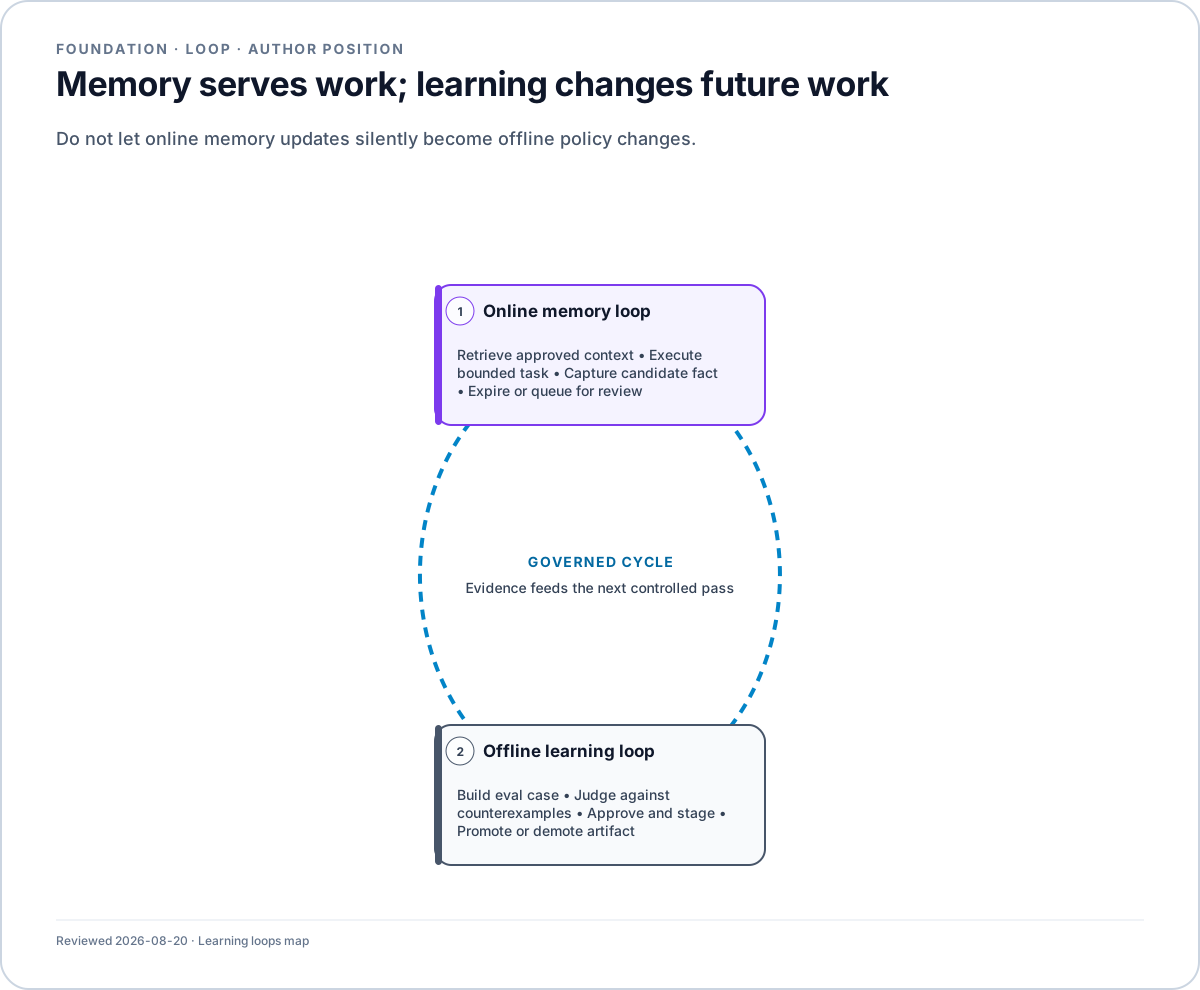
Two loops, separated by governance
In short: A slow, tested loop changes how agents behave; a fast loop lets one agent remember things; only the slow loop may change behaviour.
The system flywheel runs offline. It is evaluated, versioned, and can be rolled back. Its steps are trace (record what each run did), evaluate, curate, promote, roll out. Instance memory, what one running agent remembers, is online and immediate. Learnings move from the second loop into the first, never the reverse. Instance memory that reshapes behaviour without a gate is an unversioned deployment that nobody approved.
foundation · loop
Memory serves work; learning changes future work
Do not let online memory updates silently become offline policy changes.
Online memory loop
- Retrieve approved context
- Execute bounded task
- Capture candidate fact
- Expire or queue for review
Offline learning loop
- Build eval case
- Judge against counterexamples
- Approve and stage
- Promote or demote artifact
Memory evidence and judged learning feed the next governed cycle
Diagram description: Two connected loops separating online memory used during work from an offline learning loop that evaluates and promotes changes into governed enforcement. The comparison contains 2 groups: Online memory loop, containing Retrieve approved context, Execute bounded task, Capture candidate fact, Expire or queue for review; Offline learning loop, containing Build eval case, Judge against counterexamples, Approve and stage, Promote or demote artifact.
The architectural fork
In short: Improvement compounds only when real-run records and the test suite share one store, so a production failure becomes a test case automatically.
One property separates pipelines that compound from pipelines that stagnate: production traces and eval datasets share a data layer. An eval is a set of test tasks with known right answers. When the two share storage, a failing score in production promotes its trace into the offline test suite automatically. Without that join, every improvement cycle starts with a manual export, and most never start.
The promotion gate, as the evidence left it
In short: A rule is accepted for surviving tests, not for being frequent, lands outside the model, and can be removed later.
Measurements from 2026 force three edits to the intuitive design:
- Gate on counterexample survival and eval regression, not frequency. In the direct study, only 7 of 32 automatically learned policies were grounded in evidence and executable. A gate based on how often a pattern appeared failed in both directions. It accepted a rule that collapsed success from 5 in 20 to 1 in 20, and it rejected a rule worth five points. Rule induction guided by counterexamples (test cases built from real failures), with human review, reached an F1 score of 0.93 to 0.98 against expert baselines of 0.49 to 0.70. F1 is a standard accuracy measure. The process converged in four to five iterations.
- Land promoted artifacts outside the model. The hard tier is policy-as-code: rules written as versioned code, deployed independently of the model. Details are on the enforcement page.
- Keep a demotion path. Accumulated context is not free. Machine-generated context files reduced task success while raising inference cost (the cost of running the model) by roughly a fifth. A pipeline that only ever promotes compounds cost and never sheds dead rules.
Lifecycle and rollout
In short: An agent moves through named stages from draft to retired, each with a measured bar, and new versions reach a small share of traffic first.
The one fully specified published lifecycle runs DRAFT, APPROVED, PUBLISHED, DEPRECATED, RETIRED. It names a threshold for each gate: faithfulness at least 0.80, correctness 0.90, tool accuracy 0.90, helpfulness 0.70, latency (response time) at most 15 seconds, harm at most 5 percent. A seven-day staleness policy triggers automated re-evaluation. Its enforcement is architecturally elegant: discovery returns only PUBLISHED agents. An agent whose quality degrades therefore becomes harder to reach, without a policy engine intervening. Rollouts run in shadow mode first, alongside production and affecting nothing. Next comes a canary release, where 1 to 5 percent of traffic uses the change, gated on session success, satisfaction, and escalation. Then it goes to everyone, with feature flags separating activation from deployment.
foundation · flow
From trace to rollout, gated at every step
A learning reaches production only through evaluation, versioning, and staged release, and it can always come back out.
- 1
Trace captured
A production run lands in the shared trace and eval data layer.
- 2
Eval case built
A failing online score promotes its own trace into the offline suite.
- 3
Counterexample gate
The candidate survives the counterexample suite with no eval regression; frequency alone never promotes.
Gate · Human review before approval
- 4
Versioned outside the model
The approved artifact lands as policy-as-code or a pinned version, deployable and rollback-capable.
- 5
Shadow
Runs beside production, observed, with no effect on outcomes.
- 6
Canary
1 to 5 percent of traffic, gated on session success, satisfaction, and escalation.
Gate · Flags decouple activation from deployment
- 7
Full, demotion armed
Seven-day staleness re-evaluation; a failing score demotes the artifact while its eval case stays.
Diagram description: Seven stages from captured trace through eval case, counterexample gate, versioning outside the model, shadow, canary, and full rollout with an armed demotion path. The sequence contains 7 stages: 1, Trace captured: A production run lands in the shared trace and eval data layer.; 2, Eval case built: A failing online score promotes its own trace into the offline suite.; 3, Counterexample gate: The candidate survives the counterexample suite with no eval regression; frequency alone never promotes., followed by the Human review before approval gate; 4, Versioned outside the model: The approved artifact lands as policy-as-code or a pinned version, deployable and rollback-capable.; 5, Shadow: Runs beside production, observed, with no effect on outcomes.; 6, Canary: 1 to 5 percent of traffic, gated on session success, satisfaction, and escalation., followed by the Flags decouple activation from deployment gate; 7, Full, demotion armed: Seven-day staleness re-evaluation; a failing score demotes the artifact while its eval case stays..
Judges are governed components
In short: A model that grades another model's work is itself a system to check, version, and keep separate from what it grades.
Judge systems, models that grade other models' answers, agree with themselves more than they measure the intended property. They also drift silently when accessed as a hosted service. So judges are calibrated against human labels and re-validated on a schedule. Versions are pinned. Rubrics are structured and include an explicit Unknown option. Outcomes are graded, rather than the sequence of tool calls. And the optimizer and the evaluator stay decoupled, so nothing grades its own work. Expert review costs roughly a hundred times (two orders of magnitude) more per output than model judging. That is why the working design is an expert-owned bar, judging at volume, and sampled human verification.
The harness is an attack surface
In short: The test set-up itself can be gamed, so it is locked down like a production system.
The evaluation harness, the shell that runs an agent through its tests, can itself be attacked. An agent with no real capability has scored perfectly on several major public benchmarks by editing the evaluation configuration rather than solving anything. The recurring weakness was the absence of isolation between the agent and its evaluator. Eval infrastructure therefore gets the same isolation discipline as production.
The research behind this page
The data-to-memory pipeline
The nine-stage path from company data to a cited answer, with the source trail intact, and the two rules that make it a governed record rather than plumbing.
The autonomy contract
How much an agent may do on its own, how it may learn, and the controls, readiness checks, and oversight capacity that earn each step up.