The concern matrix
Ten cross-cutting concerns against fourteen layers: who owns each, who enforces it, and the six gaps with no complete answer anywhere.
How to read it
Every layer page closes with its own row for the ten cross-cutting concerns, C1 to C10. A layer is one of the fourteen parts of the estate that agents touch, and a concern is a requirement every layer must honour. This page is the view across all fourteen layers. Three words carry the distinction that matters. Owned means the layer defines the requirement and holds accountability for it. Enforced means the place where a violation is actually stopped, which is frequently a different layer. Inherited means the layer must carry the property through without weakening it. Inheritance is where most defects live, because it fails silently. The register applies at every autonomy level and tightens as autonomy rises.
foundation · matrix
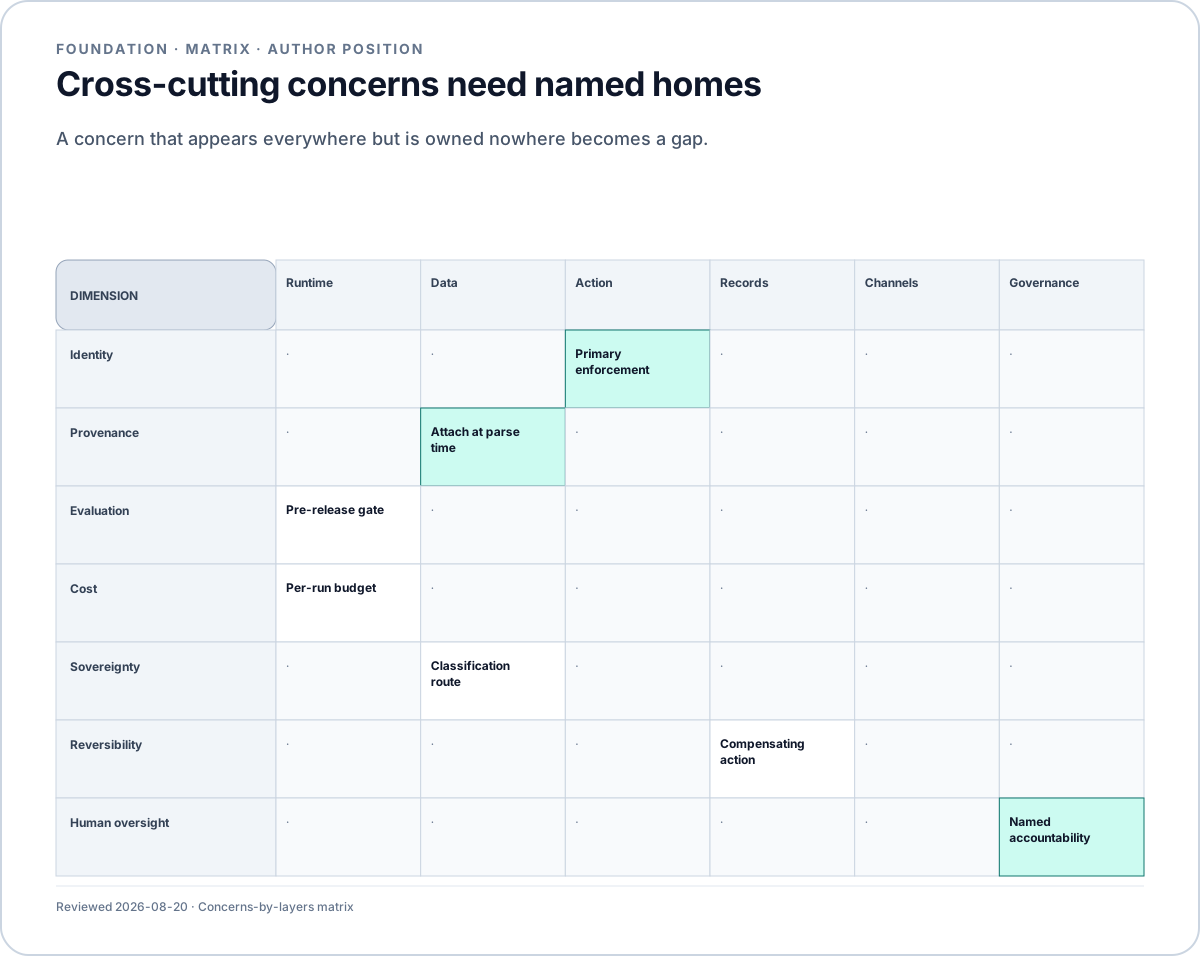
Cross-cutting concerns need named homes
A concern that appears everywhere but is owned nowhere becomes a gap.
Identity
- Action:Primary enforcement
Provenance
- Data:Attach at parse time
Evaluation
- Runtime:Pre-release gate
Cost
- Runtime:Per-run budget
Sovereignty
- Data:Classification route
Reversibility
- Records:Compensating action
Human oversight
- Governance:Named accountability
Diagram description: Heatmap concept showing identity, provenance, cost, evaluation, sovereignty, reversibility, and human oversight crossing all fourteen enterprise layers. The matrix crosses Identity, Provenance, Evaluation, Cost, Sovereignty, Reversibility, Human oversight with Runtime, Data, Action, Records, Channels, Governance. Annotated cells are Identity by Action: Primary enforcement; Provenance by Data: Attach at parse time; Evaluation by Runtime: Pre-release gate; Cost by Runtime: Per-run budget; Sovereignty by Data: Classification route; Reversibility by Records: Compensating action; Human oversight by Governance: Named accountability.
Owned and enforced
In short: For each requirement, this table names who sets the rule, who stops a violation, and what goes wrong when the two are confused.
- #
- C1
- Concern
- Identity and access
- Owned at
- R10
- The failure when this is wrong
- Identity asserted but never checked at the point of action
- #
- C2
- Concern
- Observability
- Owned at
- R12
- Enforced at
- Emitted by every layer, aggregated at R12
- The failure when this is wrong
- The licensed estate emits into its own console and coverage only looks complete
- #
- C3
- Concern
- Traceability and audit
- Owned at
- R11
- The failure when this is wrong
- Evidence reconstructed after the incident instead of produced as a byproduct
- #
- C4
- Concern
- Grounding
- The failure when this is wrong
- Answering over weak evidence instead of refusing
- #
- C5
- Concern
- Impersonation and authenticity
- Owned at
- R10
- The failure when this is wrong
- Agent-to-human trust exploitation, named in the current threat taxonomies
- #
- C6
- Concern
- Sovereignty and residency
- Owned at
- R11
- The failure when this is wrong
- Residency held at the source and broken by an embedding, a trace, or a session artifact
- #
- C7
- Concern
- Privacy
- Owned at
- R11
- The failure when this is wrong
- Deletion succeeds in the record and fails in the vectors, memories, and telemetry
- #
- C8
- Concern
- Safety and oversight
- Owned at
- R13
- The failure when this is wrong
- Oversight on the org chart but not in the workload
- #
- C9
- Concern
- Cost
- Owned at
- R12
- The failure when this is wrong
- Spend attributed to a platform rather than a sponsor; supervision labour absent from the case
Seven invariants
In short: Seven rules came up on their own in three or more layers, so the guide treats them as fixed requirements rather than recommendations.
Each surfaced independently in three or more layers, which is why they are invariants, rules that must always hold, rather than recommendations:
- Derived artifacts inherit the strictest classification of their sources. That includes chunks, embeddings, session artifacts, traces, and fine-tuned weights.
- Erasure cascades or it did not happen. When a record is deleted, so are its vectors, memories, traces, telemetry, eval datasets, and derived artifacts.
- Every layer degrades to a human queue, and containment (conversations that never reach a person) is never manufactured by making the queue unavailable.
- Telemetry is collected outside the agent's control. Self-report is testimony, not evidence.
- The kill switch is multi-point (runtime, gateway, harness, identity plane), and an observability outage must not blind it.
- Enforcement is deterministic and outside the model. It is held in the harness and enforced at the gateway or policy decision point (PDP).
- Provenance travels inside the artifact, attached at parse time, when the document is first processed; provenance stored alongside is out of sync when it matters.
The open gaps
In short: Six problems have no complete solution anywhere yet, and the guide says so rather than pretending otherwise.
The gaps below are published as unsolved. A matrix without holes would be the least credible artifact in this guide.
- Gap
- Permissions on many-to-one derived artifacts
- Layer
- R14
- Status, August 2026
- No complete published solution; intersection-stamping is the emerging practice
- Gap
- Behavioural baselining for agents in the SOC (security operations centre)
- Layer
- R10
- Status, August 2026
- Unsolved; agent behaviour is legitimately variable, so both human and workload baselining methods misfire
- Gap
- Multi-agent incident reporting
- Layer
- R11
- Status, August 2026
- No frame exists for who reports what when several agents contribute to one incident
- Gap
- Error budgets for agent quality
- Layer
- R12
- Status, August 2026
- No published enterprise analog; an open pattern, not a practice
- Gap
- Human-to-agent supervision ratio
- Layer
- R13
- Status, August 2026
- No credible published figure from any source
- Gap
- Embedded versus external agent outcomes
- Layer
- R04
- Status, August 2026
- No published head-to-head measurement on identical tasks
The research behind this page
The autonomy contract
How much an agent may do on its own, how it may learn, and the controls, readiness checks, and oversight capacity that earn each step up.
The fourteen layers
One page for each of the fourteen parts of the enterprise estate that agents touch: what good looks like, how it is built, the choices made, and what the evidence supports.